Study Destination Ireland
Popular University Courses in Ireland








Ireland has earned the nickname “the Silicon Valley of Europe” for good reason. The country is home to 9 out of the top 10 American tech companies, including Google, Facebook, and Apple.

- Ireland is an island nation on the westernmost edge of Europe. It is the continent’s second largest island (after Great Britain). The Republic of Ireland occupies 80 percent of this landmass, while a large chunk of land in the north is part of the United Kingdom.
- Ireland is known for its wide expanses of lush, green fields. In fact, its nickname is the Emerald Isle. But there are also large areas of rugged, rocky landscape. About 15,000 years ago, Ireland was completely covered by thick glaciers. The movement of these giant sheets of ice stripped the soil, leaving huge tracts of flat, limestone pavement.
- The midlands and west coast of Ireland are dotted with damp peat bogs, the soggy remains of dried-up ancient lakes left by the glaciers. Ireland’s highlands rise mainly in the southwest, often ending at sheer cliffs that plunge thousands of feet into the Atlantic Ocean.
- The Irish has a great affection for nature and rural life. The country’s first coins even featured pictures of animals. Low levels of development and pollution in Ireland have left most of the nation’s open spaces relatively undisturbed.
- Did you know that there are no wild snakes in Ireland? The sea has stopped many animals common on mainland Europe from reaching the island. There are also only two wild mouse species, one type of lizard, and just three kinds of amphibians.
- Irish wildlife is protected by government conservation programs. To preserve natural habitat, the government has established six national parks and hundreds of national heritage areas throughout the country.
- Land Area:26,598 sq mi (68,889 sq km); Total Area:27,135 sq mi (70,280 sq km)
- Population (2014 est.):4,832,765 (growth rate: 1.2%); birth rate: 15.18/1000; infant mortality rate: 3.74/1000; life expectancy: 80.56
- Capital (2011 est.): Dublin, 1.121 million
- Monetary Unit: Euro
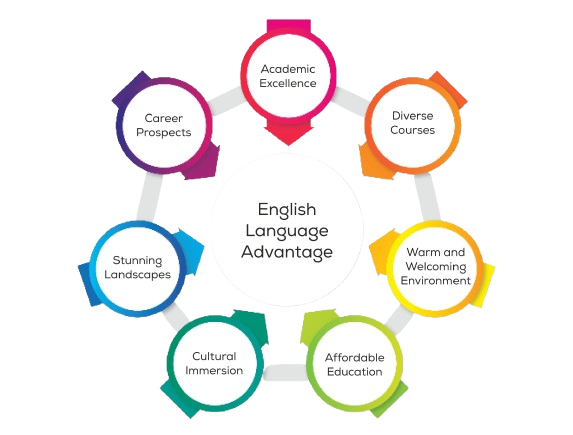
Top 8 Reasons to Study in Ireland
- Academic Excellence
- Diverse Courses
- Warm and Welcoming Environment
- Affordable Education
- Cultural Immersion
- Stunning Landscapes
- Career Prospects
- English Language Advantage
What is the cost of living in Ireland?
The estimated cost of living in Ireland for a student for one academic year is €7,000 to €12,000 per year. This includes rent, electricity, food, books, laundry and medicine, as well as travel passes and social expenses, but excludes tuition fees.
What are the tuition fees in Ireland?
Foundation courses fee range between €6,500 to €13,500
Undergraduate courses fee range between €6,000 to €15,000
Postgraduate courses fee range between €10,000 to €30,000
Fees vary depending on your chosen field of study, program, and university or institute.
Is studying in Ireland expensive?
While tuition fees in Ireland are not inexpensive, they are generally lower than those in the UK. On average, international students pay between €9,000 and €25,000 per year, depending on the program and university
The Irish Council for International Students (ICOS) was founded in 1970, and its offices are based in Dublin on the Morehampton Road.
ICOS promote the rights and welfare of international students who choose Ireland as a study destination, and support staff in colleges who work with them.
The Irish Council for International Students (ICOS) is
available to contact for any international students who need
assistance: info@icosirl.ie
Important Links
Visa Requirements For Students Applying For Ireland
https://www.irishimmigration.ie/coming-to-study-in-ireland/what-are-my-study-options/a-fee-paying-private-primary-or-secondary-school/information-on-student-finances/
Purchase an Education Bond
https://educationbondireland.transfermateeducation.com/
Approved English Tests are listed at
https://www.irishimmigration.ie/coming-to-study-in-ireland/english-language-requirements-for-study-visas/
Visa Decisions and Current Processing Time
https://www.irishimmigration.ie/visa-decisions/
Department of Foreign Affairs
https://www.ireland.ie/en/dfa/citizenship/
Department of Further and Higher Education, Research, Innovation and Science
https://www.ireland.ie/en/dfa/citizenship/
Department of Enterprise, Trade and Employment
https://enterprise.gov.ie/en/